Showing posts with label Romans. Show all posts

Monday, February 15, 2010

Time Wasting Ahoy!


First of all, if you ever want to have a productive day at work again, you probably shouldn't read any further. We here at De Koboldorum Rebus will accept no liability, etc. etc.

So, anyway, Sporcle. If you have not yet encountered Sporcle, it is a site given over to a very large number of user-created quizzes, on just about any subject imaginable. The best bit is that, once you have finished the quiz, you can take a pick at which answers were most commonly missed, and how your quiz score fits in with the rest of the world.

Sporcle, we are proud to announce, has now been infiltrated by kobolds. Yes, you can take, for example, your new-found expertise in the esoterica of NHL awards over to Sporcle and put it to use! And there are other res koboldorum to be found as well, not to mention a couple coming up the pipe...

Thursday, October 29, 2009

Joyeux Anniversaire!

Fifty years ago today, on October 29th, 1959, the French comics magazine Pilote published its first issue. Defunct since 1989, Pilote would probably not be much remembered, except that one of its comics turned out to have quite a lot of sticking power, and if you've been over to Google today, you know which one it was.


Yes, today is the 50th birthday of Asterix, Obelix, and the rest of the village of indomitable Gauls, the brainchildren of Rene Goscinny and Albert Uderzo. And anyone who appreciates humour, or ancient history, or any combination thereof, owes those two gentlemen a deep debt of gratitude.

Personally, I think my favourite is Le Tour de Gaulle d'Asterix, mostly because it's the one in which they acquire Idefix, but that's just me...

Tuesday, March 3, 2009

We Have Been Awarded


A Kreativ Blogger Award has come our way courtesy of Chorus! Thank you, thank you!

*waves to crowd, gives long tedious speech*

And so, down to business! First of all, I must list 7 things that I love:

  • Most sports, but especially soccer, hockey, and baseball.


    View Larger Map


  • Cats!


  • Seafood!


  • Like the song says, giant squids (this is possibly related to the item immediately above)!


  • The poems of Catullus


  • Italy, especially the South. And the food...


  • Ancient Romans


By no means a complete list, but there you go! And now, to pass on the award to 7 other deserving blogs! Well, most of the blogs that I would normally pick have already been tagged with this, so I'm only going with two right now, with an option to add more later:

EvilElitest
Pack Animal Existance

Wednesday, February 4, 2009

HONK HONK HONK!!!!


The image above (you may click on it to make it bigger) shows a fairly famous scene from ancient Roman history. You will notice the band of men in the foreground making a pyramid in order to ascend the last bit of Rome's Capitoline Hill. They are Gauls, and they are up to no good.

It was about 389 B.C., and the Gauls, irritated by a Roman violation of international law, had managed to take the lower city of Rome and pen the survivors up in the citadel atop the Capitoline Hill. This resulted in a bit of a stalemate, until the Gauls spotted a narrow track up the hill, and snuck up it one moonlit night, as depicted in the scene above. They were so successful in their sneaking that, according to Livy, they did not even wake the dogs. However, their luck ran out at the top of the climb, when the lead Gaul attained the summit and discovered himself in the pen containing the geese sacred to the goddess Juno (they are also in the above picture). His arrival did not please the geese, which brings us to the title of this post.

The resulting expression of avian dismay woke up one Marcus Manlius (later, as a result of his exploits that night, Marcus Manlius Capitolinus), he woke up his comrades, and the Gaulish assault was thrown back. One of the more amazing aspects of this episode, again according to Livy, is that the Romans had not yet gotten around to eating the sacred geese (the food shortage on the hill was severe, and in fact eventually led to the Romans simply paying the Gauls a lot of money to go away).

I mention this episode not simply because it is one of my favourite stories from Roman history (it is), but because that particular passage of Livy (V.47) turned up on my Latin comprehensive exam last week, along with some bits from Catullus and Vergil (I elected not to try my hand and the passages from Cicero, Horace, and Tacitus). And, just yesterday, I received the official word that I passed the thing, and indeed that the examiners thought that some of it had been translated "quite elegantly." So that is that out of the way, and it is now onto the Greek, thanks at least in part to Marcus Manlius and the geese!

Friday, January 9, 2009

Ignis! Ignis!

So I snuck into a classroom this morning and taught Latin to the bemused students within! An incident of "guerilla Latin-teaching"? Not really. More a case of "filling in for a friend who's out of town" Latin-teaching. And the students were only slightly bemused. However, in the course of our discussions this morning, we wandered onto the topic of this man:


That man is Marcus Licinius Crassus, member of the First Triumvirate and putter-down of Spartacus' revolt. He was also spectacularly wealthy, at least partially because of the fact that he owned and operated one of Rome's first fire departments. And how did that work? Well, to explain the matter, here is The Official De Koboldorum Rebus Guide to Having Your Building Catch Fire in Rome in the 60s B.C.:

  • Step One: Your building catches fire.

  • Step Two: A number of shady-looking individuals show up with buckets. They belong body-and-soul to M. Licinius Crassus. If this were an episode of C.S.I., the phrase "tested positive for accelerants" might well come into play.

  • Step Three: With your building merrily burning down in the background, the men with buckets make you an offer for the property. Of course, this offer is well below market value, on account of the building being on fire.

  • Step Four: Step Four depends on whether you have the accepted the offer in Step Three. If you have, the men put the fire out. Of course, your building now belongs to M. Licinius Crassus. Perhaps he will sell it back to you, for full market value of course since it's not on fire any more. If you did not accept the offer, then the men go away, leaving you to deal with your rapidly devaluing property on your own.


As I mentioned, Crassus got very very rich off of schemes like the one above. His wealth, however, did not save him from a rather gruesome end, at least according to legend. In 53 B.C., at Carrhae in what is now Turkey, Crassus led an army into one of Rome's all-time great military disasters, against the Parthians. He was subsequently captured. According to some sources, the Parthians, who knew of Crassus' great wealth and had a bit of a sense of humour, "quenched Crassus' thirst for riches" by forcing him to drink molten gold.

Friday, November 28, 2008

Missing Something?


A graffito from Pompeii:

equa esiquei aberavit cum semuncis honerata a d
VII Kal Septembres Decembres
convenito Q Deciu Q l Hilarum aut L Decium L
l Amphionem citra pontem
Sarni
fundo
Mamiano


Translated (loosely):

"If somebody lost a horse loaded with saddlebags on the 25th of November, get in touch with Quintus Decius Hilarus (freedman of Quintus) or Lucius Decius Amphio (freedman of Lucius) at the estate of Mamius on this side of the bridge over the Sarno."

Nice to see people doing the right thing!

Thursday, November 13, 2008

This Looks Interesting!

Google Earth revives ancient Rome

Google has added a new twist to its popular 3D map tool, Google Earth, offering millions of users the chance to visit a virtual ancient Rome.


I think I need to get a computer and put Google Earth on it! Then I can indulge in writing peevish blog posts saying things like: "Well, they obviously got the Temple of Mars Ultor all wrong..."

Kidding. I've seen a few virtual reality reconstructions of ancient sites, and they tend to be really really cool. It's likely that this one will be too!

The Temple of Mars Ultor, as it is today

Friday, October 24, 2008

Inscriptions!!

When I teach Latin in the summer, I am usually placed in a so-called "smart" classroom, which has built-in multi-media capabilities. However, this fall I am in an old-fashioned classroom, and thus have to lug the multi-media in on my own. Which is why this morning found me hauling an LCD projector and laptop into the classroom and fiddling with them while my students wrote their quiz. Yes, today was their first introduction to Roman inscriptions! And here's what I showed them (Warning: Roman tomb inscriptions can be quite powerful!):


The inscription from the Pantheon in Rome! Translated, it reads "Marcus Agrippa, son of Lucius, made [this] during his third consulship." Agrippa, the son-in-law and close friend of Augustus, did indeed oversee the construction of the Pantheon in 27 B.C. However, his edition of the building burned down in A.D. 80, and was rebuilt under Hadrian. Hadrian, however, decided to go with the original inscription.


One of the inscriptions from the Arch of Titus (actually constructed by Domitian in about A.D. 81). "The Senate and the People of Rome [dedicate this] to the divine Titus, son of the divine Vespasian, and to Vespasian Augustus." The little holes in the letters are nail-holes; originally, there were inset bronze letters, but these have been looted. Interestingly, the name of the emperor does not appear here. This omission is possibly the result of Domitian trying to distance himself from his brother Titus, whom he quite possibly murdered.


Leaving aside public architecture, here we have the base of a statue from Britain. The inscription reads: "The soothsayer Lucius Marcius Memor gives [this] as a gift to the goddess Sulis." Sulis was a Celtic deity associated with the hot-springs at Aquae Sulis (literally, "Waters of Sulis"), the city now known as "Bath." What's interesting about this particular inscription is the tremendous use of ligatures, which is what you get when you combine two or more letters into one. Note, for example, the "M," "A," and "R" in "Marcius." Incidentally, we still make use of a common Latin ligature; it's "&," which is comprised of an "e" and a "t" squashed together, thus giving you the Latin word "et," meaning "and."


Most of our Latin inscriptions come from tombstones, of course (I mean, where would you go if you wanted to see a bunch of English inscriptions in one place?). Here's one that reads: "To the divine Shades and to Dionysius her most pious brother, [who] lived 21 years, Chrysopolis, his sister, made [this]." Given that we have Greek names showing up on a Latin inscription, it's very likely that both Chrysopolis and Dionysius were slaves. Obviously, though, they'd managed to salt away enough money to afford a tombstone; either that, or they had a master generous enough to pay for it himself and let Chrysopolis put her name on it. In either case, they were probably skilled slaves; field-hands or galley-slaves would not have been able to afford something like this.


This one's rather sweet, I think. We have here the tomb of a young boy. The inscription reads: "To the divine Shades of Anthus. Lucius Julius Gamus, his father, [made this] for his most sweet son." I particularly like the puppy; the Romans did keep pets (cats, dogs, birds, etc.), and if we are to judge by the image here, young Anthus had a little dog of whom he was fond.


"To the divine Shades of Minicia Marcella, daughter of Fundanus. She lived for 12 years, 11 months, 7 days." We actually know a little bit about Minicia Marcella. Her father, Fundanus, was a good friend of the writer Pliny the Younger, and thus we have the following, from a letter written by Pliny:

"Caius Plinius greets his friend Marcellinus." (i.e. "Dear Marcellinus") "I, very sad, write these things to you, the younger daughter of our friend Fundanus having died. I have seen no-one anywhere more pleasant, more lovable, or more worthy of a longer life than that girl. She had not completed 13 years, but already had the wisdom of an old woman, the dignity of a matron, and yet a girlish sweetness. How she clung to her father's neck! How both lovingly and modestly she embraced us, her father's friends! How she loved her nurses, her tutors..." The letter goes on to complete the portrayal of a well-educated, well-brought-up, and immensely beloved young lady.


And, finally, my favourite. This one's from northern England, up near Hadrian's Wall. The grammar in the inscription is a bit shaky, but, loosely translated, it reads: "To the divine Shades. Regina, freedwoman and wife, Catuvellaunian by nation, lived 30 years. Barates the Palmyrene [made this for her]." We have here the story of a man (Barates) from Syria moving to northern Britain, and one wonders how he dealt with his first British winter. There, he falls in love with one of his slaves, a Celtic woman named Regina (the Catuvellauni were one of the Celtic tribes of Britain). He subsequently frees and marries her, and I would take this opportunity to point out that neither of those would have been necessary if all he'd wanted to do was sleep with her. After her death, he commissions an enormous, elaborate tombstone (compare it to that of Minicia Marcella, whose father had been consul!). And, as a final touch, he adds, at the bottom of the inscription, a single line in Aremaic, his first language. It reads, poignantly, "Regina of the Catuvellauni, alas!" I nice little story, I think!

Anyway, the class seemed to enjoy looking at the inscriptions, which was the main thing. Hopefully, as well, it will have gone some way to reminding them that we are actually dealing with REAL people who ACTUALLY EXISTED! This message sometimes get lost when one is working almost exclusively with the canon of Latin literature.

Friday, September 26, 2008

More Marine Mosaicing!

Here are a couple more pictures from the Womens' Baths at Herculaneum (note: yesterday's squid is visible in the octopus picture!


And, a story, related to edible marine life. My corner of The Warrens is a long, long, way from the Big Water, which is somewhat inconvenient given that I do like teh seafood! So, whenever I find myself in an area where such fare is plentiful and good (like, say, the Bay of Naples), I tend to indulge liberally. And so, one evening this past summer, I found myself in a little restaurant in Vico Equense, examining the menu and discovering that it included grilled calamari. This seemed to be just the thing, so I ordered it. The waiter made approving noises, took my order and went away. A little while later he returned, bearing a plate.

And on that plate, there was a squid.

And I do mean, here, an entire squid (grilled, at that). Well, the internal bits had been removed, but it was otherwise intact. Unfortunately, I did not have my camera at hand, or I'd show photographic proof. I am used to calamari being in the form of deep-fried rings and sort of tentacly pieces, and I had never seen it fully assembled like that.

So I ate the squid, and it was good.

Thursday, September 25, 2008

Picture Of A Squid

Because why not, that's why!


Anyway, it's from the Womens' Baths at Herculaneum.

Saturday, August 2, 2008

And A Very Happy Dies Natalis To You!

So I was busy the other day attempting to come up with a bonus question for the exam I intended to inflict on my poor Latin students on Friday (Note: exam was duly inflicted). And since we had just week taken a look at some of the more interesting graffiti from Pompeii and Ostia, it seemed a good idea to give them their very own graffito to try to untangle. I should point out here that ancient Roman creators of graffiti were just as in touch with the idea of good spelling and grammar as their modern counterparts. Anyway, I think that the graffito I chose, in the end, is actually quite lovely. It's from Pompeii, and was/is located in Via della Fortuna, a street of shops and houses located North of the Forum.


Via della Fortuna


Unfortunately, very unfortunately, I don't have a photo of the actual graffito itself. However, it reads:


Iuen
illa nata
diie Satu
ora secu
v IIII Non Au


And what does it say? Well, the first line, "Iuen," is a shortened form of the name "Iuenilla," which is itself a variant spelling of "Iuvenilla," a common Roman girl's name. We know this because next to the graffito the name is spelled out in full, around a drawing of a baby. Why a baby? The next line of the graffito explains that. It translates as "that (girl) was born," with the form of the verb "to be" left out. We are dealing here with the announcement of a birth.

The third line, "diie Satu," contains a misspelling. "Diie" should, in fact, be "die," in the ablative case indicating time when, and thus meaning "on the day." "Satu" is short for "Saturni," meaning "of Saturn." Thus we end up with "on the day of Saturn" - in other words, "on Saturday." The Romans did have a seven-day week by this time, with the days named after celestial bodies, a practise that most Romance languages have followed, and that is preserved in English in the names "Saturday," "Sunday," and "Monday."


Break Time! Here's Mount Vesuvius, on a glowery sort of day.


On to the fourth line, then! "Ora" is again in the ablative case for time when. In "proper" written Latin, it would have been "hora," but the initial "h" very often drops out in more colloquial writings, and probably did so in speech as well. "Secu" is short for "secunda," also in the ablative case agreeing with "ora." Taken together, it means "at the second hour."

The last line is where it gets a bit tricky. At first glance, it would appear to translate as "nine (v IIII) days before the Nones (Non) of August (Au)," a Roman date written in the standard format. However, the problem here is that you cannot have a date written as "nine days before the Nones." The Roman month had three Named Days: the Kalends (the first day of the month, and from which we get the word "calendar"), the Nones (the 5th or the 7th, depending on the month), and the infamous Ides (the 13th or 15th). The actual date of a particular day was reckoned based on how many days it was until the next Named Day. Nine days before the Nones would be back before the Kalends, and thus the date would have been written "so many days before the Kalends of August." Therefore we must dispense for now with the "v," and read this as "four days before the Nones of August." The Nones fall on the 5th in August. However, just to be difficult, the Romans reckoned inclusively, so in counting backwards, we must count the 5th, not the 4th, as "1." And so we count off the days: 5th, 4th, 3rd, 2nd. Iuvenilla was born on Saturday, the 2nd of August.

*Pauses to check today's date*

Finally, we must do something with the "v" in the last line. It actually goes with "ora secu" in the line above, and stood for "vespertina," or "vesprae," or "vesperi," or "vesperis." It doesn't really matter which of them it is, as they all mean, roughly, "evening," so we are dealing with the second hour of the evening. Like us, the Romans had a 24-hour day. However, they achieved this by dividing the time between sunrise and sunset into 12 equal portions, and doing the same for the time between sunset and sunrise. This meant two things. First of all, except at the Equinoctes, the daytime hours were not the same length as the night hours. Secondly, the length of a Roman hour changed over the course of the year, ranging from about 44 minutes to about 76, with the day hours at their longest when the night hours were shortest, and vice versa. And so, after doing a bit of research on when the sun rises and sets in Italy in early August, we can say with some confidence that Iuvenilla was born at around 10:00 pm.


Artist's rendering of the eruption of Vesuvius in A.D. 79


Ok, then, to put it all together, we end up with this:

Literal translation: "Iuvenilla. That girl was born on the Day of Saturn, at the second hour of evening, 4 days before the Nones of August."

Less literal translation: "Iuvenilla. The girl was born on Saturday, August 2, at about 10:00 pm."

Our anonymous graffito-writer has not given any indication of the year of Iuvenilla's birth. However, if we accept two completely unprovable premises, we can at least make an educated guess. First premise: that the calendar has not been distorted at any time, apart from the switch from the Julian version to the Gregorian (September 1752 for Britain and her North American colonies, incidentally), and that therefore we can actually compute accurately the days of the week for a particular ancient year. This is not, perhaps, as unlikely as it might seem. Second premise: That the graffito refers to the last August 2 to fall on a Saturday before the eruption of Vesuvius in A.D. 79. I am tentatively assuming this simply because I think it unlikely that the graffito would have survived in any legible state for very long. If I ever see a photo of it, I may revise this opinion. Assuming these two things, then, and having found an excellent day-of-the-week calculator that takes into account the change in calendar, I would submit A.D. 77 as the most likely candidate. I would repeat, however, that there are some very big "ifs" here.

Well, this has been a very long post. I would like to close it by returning to the title, and wishing a very Happy Birthday to Iuvenilla, whoever she was (and would mention, without going into detail, the there are reasons to be optimistic that she survived the eruption)!


Thursday, March 20, 2008

Fun With Art!


Click to see larger version

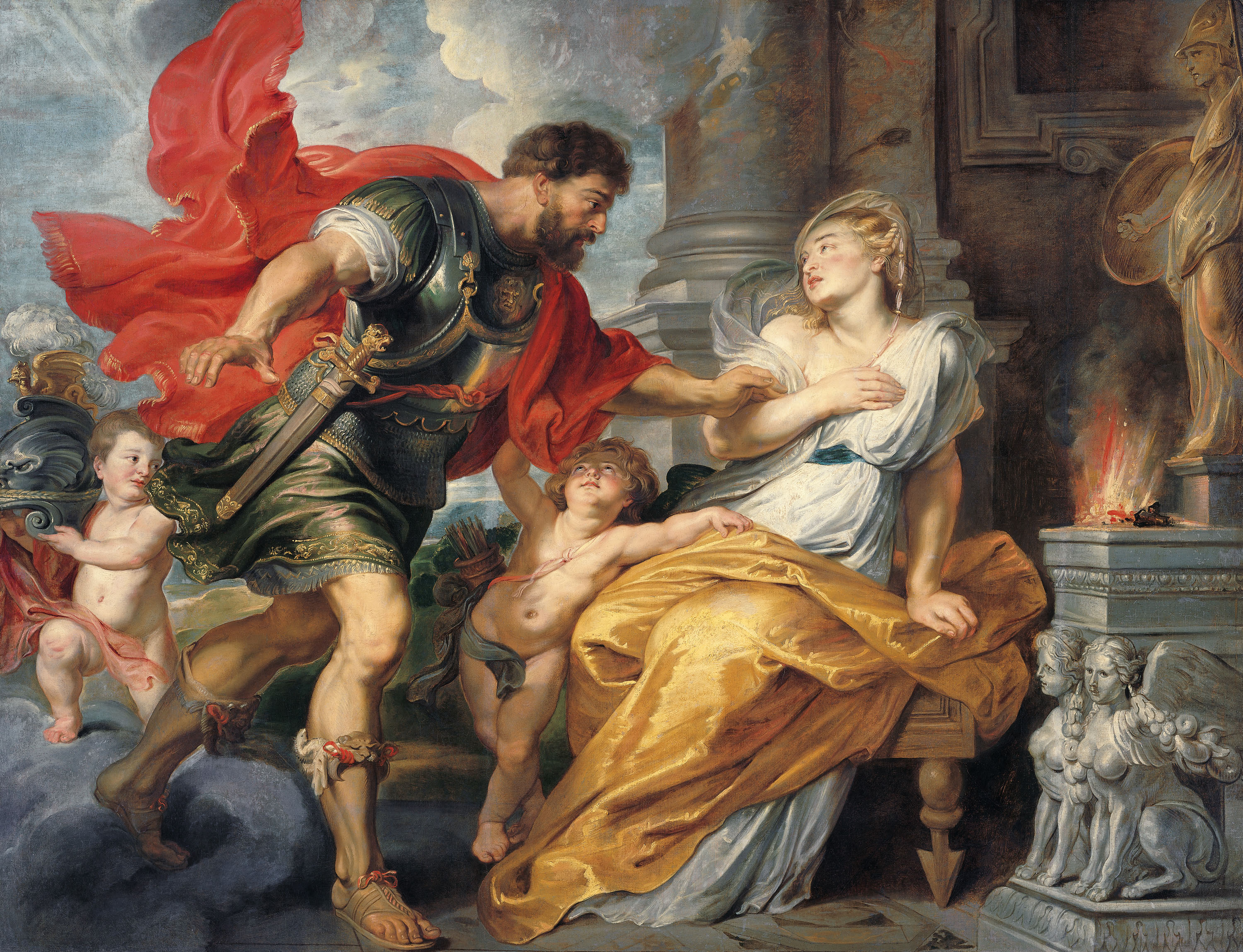
That is Peter Paul Rubens' painting of Mars and Rhea Silvia. According to the legend, Mars loved Rhea Silvia, despite the problematic fact that she was a Vestal Virgin by occupation. Out of their union came Romulus and Remus, the legendary founders of Rome.

Anyway, in the painting, we see Mars advancing upon his beloved, while a couple of cupids remove his armour. Beside Rhea Silvia is the altar of the Temple of Vesta (I particularly like the sphinxes). On the alter, at the extreme right of the painting, is the Palladium, the statue of Athena that somehow (there are various versions of the story) made its way from Troy to Italy.

Now, there is something a little bit unusual about both Mars and the statue of Athena. Can you spot what it is? The answer is in the comments.