Showing posts with label Archaeology. Show all posts

Friday, February 4, 2011

Man's Most-Ancientest Best Friend?

Vulpes Vulples Arabica (Photo by Nepenthes)


So, if the Montreal Gazette is to be believed, it looks like mankind may have been domesticating foxes before dogs:

A Canadian-led team of researchers that discovered the oldest cemetery in the Middle East has also unearthed the remains of a red fox — buried alongside a human at the site in northern Jordan — that appears to be the world's earliest-known pet.

The site, by the way, is 16,500 years old.

Of course, it's by no means proven that these foxes were pets. It's possible, for instance, that the foxes were buried with humans for some ritual or religious reason. However, the "pet" deduction does make some sense: foxes are distantly related to dogs, which were almost certainly the first non-livestock critters to be domesticated (there is some neurological proof for this, in that the area of the brain given over to being a domestic is far larger comparatively in dogs than it is in cats). And while it's tricky to domesticate foxes, it's not impossible. It's a bit difficult to imagine foxes being used as hunting animals, but it's possible (and this is mentioned by the researchers in the above article) that they were camp scavengers who simply eventually "moved in."

In any case, it's interesting stuff, and it will become even more intriguing if more human-animal burials are discovered in the area!

Thursday, November 12, 2009

In Retrospect, Maybe They Should Have Seen That Coming...


Ahh, gargoyles - or at least, what we refer to as "gargoyles." Technically, only the ones that channel water are gargoyles; the others are chimeras. But anyway, for centuries they have gazed down from the heights of gothic architecture, frightening away evil spirits and, as mentioned, sometimes channeling away rainwater.

Back in the 1980s, the folks at the National Cathedral in Washington, D.C., discovered that they had a couple of empty niches where new gargoyles might be placed. In the interests of community outreach, they asked a number of schoolchildren for suggestions as to what sort of shape the new gargoyles should take, specifically pointing out the "scariness" aspect of gargoyles in general. And then, being good sports, they acted on the suggestions:


The other child-inspired gargoyle? A raccoon.

Monday, October 5, 2009

Yet Another Cavalcade Of Randomness!!


Because the first one was such a hit!

  • Open House at the U this past Saturday, which is always good for my fitness, since the Department and the Open House booth are in opposite corners of the campus. The most encouraging sign, on a day that went really well anyway, was the number of high-school students who came up to our booth asking not "So what is History & Classics, anyway, and what kind of job can it get me?", but rather things like "this is where I come to learn about the ancient world, right?" Good stuff.

  • On a related note, I had coffee this morning with the husband of the Director for the archaeological site in Tuscany upon which I have worked. We discussed many things, including which bits of the upcoming site publication I should expect to find myself writing, and the general state of the preservation/conservation business. It was extremely productive...

  • On a completely unrelated note, I went, along with brother and nephew, to see the Major Junior team in action on Friday night. The local boys won 3-2, despite a hairy finish, and afterwards we got to and clamber around on the catwalks up above the arena. Fun!

  • Speaking of hairy finishes, that was not how the Oilies wished to commence their season, I believe. Sigh. On the bright side, overall, the team looked pretty decent.

  • I believe that I saw a beaver swimming in the river last week - spotted him, in fact, from the bus as we were crossing a bridge. Alternatively, might have been muskrat, but it was a little big for that, I think.

  • And a neat little piece dealing with light pollution, accompanied by an absolutely stunning video, is located here. Go watch!


And that's it 'til next time!

Tuesday, August 11, 2009

Newses & Noteses

I have been reacquainting myself with the Benny cat this week, and I am pleased to say that he is in fine form, despite the presence of workers doing renovations on the house. Benny's general comfort level is steeply and inversely proportional to the number of people around him at any given moment. And, as we discovered the other night while cooking dinner, he's not a huge fan of the smoke detector; its triggering resulted in him betaking himself to the back of the closet for a couple of hours.

I also managed to get together for dinner last night with some old friends, some of whom I had not seen for a decade or more (Facebook is a nifty thing!). Cue much reminiscing about archaeology-related adventures abroad! One of the people at the gathering is involved in museum work, so, in light of recent decisions, I was happy to be able to bend her ear a little bit about the field. To make a long story short, it appears that I am on the right track at least in identifying which programs are worthwhile! I'm trying to find programs that concentrate on the conservation/preservation side of things (I'm particularly interested in doing that sort of work on-site, basically as soon as the artifacts come out of the ground), rather than those whose emphasis is on museum management and the like. Anyway, the food and company were both excellent, and I imagine that there will be more get-togethers like last night's when we can manage it!

Tuesday, July 7, 2009

Blowing Off The Dust

Wow... nearly a full month's worth of absence!

So what's new, you ask? Well, I have a new crop of Latin students, possibly as many as 12(!) when everything gets settled and sorted out. So far, they seem to be quite promising, and willing to participate, and all those good things!

And, of course, the big news. I have decided to switch gears academically, and pursue more closely the technical side of archaeology. So, there's a lot of research being done right now on Museum Studies and related programs. Not much to report on that front so far, but there's a promising looking program at the University in His Majesty's Town (the one by the big river out East). We will see what transpires with that; it will require me to bone up on my organic chemistry and, interestingly, learn "darkroom techniques."

Anyway, expect more here! There's lots to get caught up on...

Thursday, February 5, 2009

Ya See, That's Why We Wanted A Coalition Government

There's an interesting little item in the federal budget this time around, under the heading "Further Developing a Highly Skilled Workforce" (it's about halfway down the page). This tidbit reveals that the government intends to raise the funding for SSHRC - The Social Sciences & Humanities Research Council, which distributes grants to people working in, well, the social sciences and humanities (full disclosure time: the archaeological project with which I am most deeply involved would not have gotten off the ground in the first place had it not been for the generosity of SSHRC). Now, one's response to an increase in SSHRCC funding might very be "hooray, that's excellent!" And excellent it would indeed be, if the paragraph announcing said funding increase didn't end with this charming sentence:

"Scholarships granted by the Social Sciences and Humanities Research Council will be focussed on business-related degrees."

And that, Mr. Ignatieff, is why we didn't want you to prop up the Conservative government. Because in doing so, you and your party allow them to sneak little bits of their pernicious ideology into law through sleight-of-hand.

Arrrgh.

Fez tip to The Galloping Beaver.

Friday, November 28, 2008

Missing Something?


A graffito from Pompeii:

equa esiquei aberavit cum semuncis honerata a d
VII Kal Septembres Decembres
convenito Q Deciu Q l Hilarum aut L Decium L
l Amphionem citra pontem
Sarni
fundo
Mamiano


Translated (loosely):

"If somebody lost a horse loaded with saddlebags on the 25th of November, get in touch with Quintus Decius Hilarus (freedman of Quintus) or Lucius Decius Amphio (freedman of Lucius) at the estate of Mamius on this side of the bridge over the Sarno."

Nice to see people doing the right thing!

Friday, November 14, 2008

Odd...


So I trotted up to my mailbox this afternoon, and discovered therein a mysterious envelope from Newcastle upon Tyne, England. "That's strange," I thought. "I don't think I know anybody in Newcastle." Turns out that the letter was a completely unsolicited offer to publish my PhD thesis, from an outfit that knows the working title but seems unaware that the thesis has not been, you know, written yet.

My first cynical thought was "hello, vanity press!" However, I've checked out the company's website, and they do seem to be into publishing scholarly works (a three-volume edition of the works of Statius, for example). I shall have to e-mail them and find out what's up!

I shall also check around this corner of the Classical 'hood and see what the 411 is on them, yo. More bulletins as events warrant.

Thursday, November 13, 2008

This Looks Interesting!

Google Earth revives ancient Rome

Google has added a new twist to its popular 3D map tool, Google Earth, offering millions of users the chance to visit a virtual ancient Rome.


I think I need to get a computer and put Google Earth on it! Then I can indulge in writing peevish blog posts saying things like: "Well, they obviously got the Temple of Mars Ultor all wrong..."

Kidding. I've seen a few virtual reality reconstructions of ancient sites, and they tend to be really really cool. It's likely that this one will be too!

The Temple of Mars Ultor, as it is today

Friday, October 24, 2008

Inscriptions!!

When I teach Latin in the summer, I am usually placed in a so-called "smart" classroom, which has built-in multi-media capabilities. However, this fall I am in an old-fashioned classroom, and thus have to lug the multi-media in on my own. Which is why this morning found me hauling an LCD projector and laptop into the classroom and fiddling with them while my students wrote their quiz. Yes, today was their first introduction to Roman inscriptions! And here's what I showed them (Warning: Roman tomb inscriptions can be quite powerful!):


The inscription from the Pantheon in Rome! Translated, it reads "Marcus Agrippa, son of Lucius, made [this] during his third consulship." Agrippa, the son-in-law and close friend of Augustus, did indeed oversee the construction of the Pantheon in 27 B.C. However, his edition of the building burned down in A.D. 80, and was rebuilt under Hadrian. Hadrian, however, decided to go with the original inscription.


One of the inscriptions from the Arch of Titus (actually constructed by Domitian in about A.D. 81). "The Senate and the People of Rome [dedicate this] to the divine Titus, son of the divine Vespasian, and to Vespasian Augustus." The little holes in the letters are nail-holes; originally, there were inset bronze letters, but these have been looted. Interestingly, the name of the emperor does not appear here. This omission is possibly the result of Domitian trying to distance himself from his brother Titus, whom he quite possibly murdered.


Leaving aside public architecture, here we have the base of a statue from Britain. The inscription reads: "The soothsayer Lucius Marcius Memor gives [this] as a gift to the goddess Sulis." Sulis was a Celtic deity associated with the hot-springs at Aquae Sulis (literally, "Waters of Sulis"), the city now known as "Bath." What's interesting about this particular inscription is the tremendous use of ligatures, which is what you get when you combine two or more letters into one. Note, for example, the "M," "A," and "R" in "Marcius." Incidentally, we still make use of a common Latin ligature; it's "&," which is comprised of an "e" and a "t" squashed together, thus giving you the Latin word "et," meaning "and."


Most of our Latin inscriptions come from tombstones, of course (I mean, where would you go if you wanted to see a bunch of English inscriptions in one place?). Here's one that reads: "To the divine Shades and to Dionysius her most pious brother, [who] lived 21 years, Chrysopolis, his sister, made [this]." Given that we have Greek names showing up on a Latin inscription, it's very likely that both Chrysopolis and Dionysius were slaves. Obviously, though, they'd managed to salt away enough money to afford a tombstone; either that, or they had a master generous enough to pay for it himself and let Chrysopolis put her name on it. In either case, they were probably skilled slaves; field-hands or galley-slaves would not have been able to afford something like this.


This one's rather sweet, I think. We have here the tomb of a young boy. The inscription reads: "To the divine Shades of Anthus. Lucius Julius Gamus, his father, [made this] for his most sweet son." I particularly like the puppy; the Romans did keep pets (cats, dogs, birds, etc.), and if we are to judge by the image here, young Anthus had a little dog of whom he was fond.


"To the divine Shades of Minicia Marcella, daughter of Fundanus. She lived for 12 years, 11 months, 7 days." We actually know a little bit about Minicia Marcella. Her father, Fundanus, was a good friend of the writer Pliny the Younger, and thus we have the following, from a letter written by Pliny:

"Caius Plinius greets his friend Marcellinus." (i.e. "Dear Marcellinus") "I, very sad, write these things to you, the younger daughter of our friend Fundanus having died. I have seen no-one anywhere more pleasant, more lovable, or more worthy of a longer life than that girl. She had not completed 13 years, but already had the wisdom of an old woman, the dignity of a matron, and yet a girlish sweetness. How she clung to her father's neck! How both lovingly and modestly she embraced us, her father's friends! How she loved her nurses, her tutors..." The letter goes on to complete the portrayal of a well-educated, well-brought-up, and immensely beloved young lady.


And, finally, my favourite. This one's from northern England, up near Hadrian's Wall. The grammar in the inscription is a bit shaky, but, loosely translated, it reads: "To the divine Shades. Regina, freedwoman and wife, Catuvellaunian by nation, lived 30 years. Barates the Palmyrene [made this for her]." We have here the story of a man (Barates) from Syria moving to northern Britain, and one wonders how he dealt with his first British winter. There, he falls in love with one of his slaves, a Celtic woman named Regina (the Catuvellauni were one of the Celtic tribes of Britain). He subsequently frees and marries her, and I would take this opportunity to point out that neither of those would have been necessary if all he'd wanted to do was sleep with her. After her death, he commissions an enormous, elaborate tombstone (compare it to that of Minicia Marcella, whose father had been consul!). And, as a final touch, he adds, at the bottom of the inscription, a single line in Aremaic, his first language. It reads, poignantly, "Regina of the Catuvellauni, alas!" I nice little story, I think!

Anyway, the class seemed to enjoy looking at the inscriptions, which was the main thing. Hopefully, as well, it will have gone some way to reminding them that we are actually dealing with REAL people who ACTUALLY EXISTED! This message sometimes get lost when one is working almost exclusively with the canon of Latin literature.

Friday, September 26, 2008

More Marine Mosaicing!

Here are a couple more pictures from the Womens' Baths at Herculaneum (note: yesterday's squid is visible in the octopus picture!


And, a story, related to edible marine life. My corner of The Warrens is a long, long, way from the Big Water, which is somewhat inconvenient given that I do like teh seafood! So, whenever I find myself in an area where such fare is plentiful and good (like, say, the Bay of Naples), I tend to indulge liberally. And so, one evening this past summer, I found myself in a little restaurant in Vico Equense, examining the menu and discovering that it included grilled calamari. This seemed to be just the thing, so I ordered it. The waiter made approving noises, took my order and went away. A little while later he returned, bearing a plate.

And on that plate, there was a squid.

And I do mean, here, an entire squid (grilled, at that). Well, the internal bits had been removed, but it was otherwise intact. Unfortunately, I did not have my camera at hand, or I'd show photographic proof. I am used to calamari being in the form of deep-fried rings and sort of tentacly pieces, and I had never seen it fully assembled like that.

So I ate the squid, and it was good.

Thursday, September 25, 2008

Picture Of A Squid

Because why not, that's why!


Anyway, it's from the Womens' Baths at Herculaneum.

Saturday, August 2, 2008

And A Very Happy Dies Natalis To You!

So I was busy the other day attempting to come up with a bonus question for the exam I intended to inflict on my poor Latin students on Friday (Note: exam was duly inflicted). And since we had just week taken a look at some of the more interesting graffiti from Pompeii and Ostia, it seemed a good idea to give them their very own graffito to try to untangle. I should point out here that ancient Roman creators of graffiti were just as in touch with the idea of good spelling and grammar as their modern counterparts. Anyway, I think that the graffito I chose, in the end, is actually quite lovely. It's from Pompeii, and was/is located in Via della Fortuna, a street of shops and houses located North of the Forum.


Via della Fortuna


Unfortunately, very unfortunately, I don't have a photo of the actual graffito itself. However, it reads:


Iuen
illa nata
diie Satu
ora secu
v IIII Non Au


And what does it say? Well, the first line, "Iuen," is a shortened form of the name "Iuenilla," which is itself a variant spelling of "Iuvenilla," a common Roman girl's name. We know this because next to the graffito the name is spelled out in full, around a drawing of a baby. Why a baby? The next line of the graffito explains that. It translates as "that (girl) was born," with the form of the verb "to be" left out. We are dealing here with the announcement of a birth.

The third line, "diie Satu," contains a misspelling. "Diie" should, in fact, be "die," in the ablative case indicating time when, and thus meaning "on the day." "Satu" is short for "Saturni," meaning "of Saturn." Thus we end up with "on the day of Saturn" - in other words, "on Saturday." The Romans did have a seven-day week by this time, with the days named after celestial bodies, a practise that most Romance languages have followed, and that is preserved in English in the names "Saturday," "Sunday," and "Monday."


Break Time! Here's Mount Vesuvius, on a glowery sort of day.


On to the fourth line, then! "Ora" is again in the ablative case for time when. In "proper" written Latin, it would have been "hora," but the initial "h" very often drops out in more colloquial writings, and probably did so in speech as well. "Secu" is short for "secunda," also in the ablative case agreeing with "ora." Taken together, it means "at the second hour."

The last line is where it gets a bit tricky. At first glance, it would appear to translate as "nine (v IIII) days before the Nones (Non) of August (Au)," a Roman date written in the standard format. However, the problem here is that you cannot have a date written as "nine days before the Nones." The Roman month had three Named Days: the Kalends (the first day of the month, and from which we get the word "calendar"), the Nones (the 5th or the 7th, depending on the month), and the infamous Ides (the 13th or 15th). The actual date of a particular day was reckoned based on how many days it was until the next Named Day. Nine days before the Nones would be back before the Kalends, and thus the date would have been written "so many days before the Kalends of August." Therefore we must dispense for now with the "v," and read this as "four days before the Nones of August." The Nones fall on the 5th in August. However, just to be difficult, the Romans reckoned inclusively, so in counting backwards, we must count the 5th, not the 4th, as "1." And so we count off the days: 5th, 4th, 3rd, 2nd. Iuvenilla was born on Saturday, the 2nd of August.

*Pauses to check today's date*

Finally, we must do something with the "v" in the last line. It actually goes with "ora secu" in the line above, and stood for "vespertina," or "vesprae," or "vesperi," or "vesperis." It doesn't really matter which of them it is, as they all mean, roughly, "evening," so we are dealing with the second hour of the evening. Like us, the Romans had a 24-hour day. However, they achieved this by dividing the time between sunrise and sunset into 12 equal portions, and doing the same for the time between sunset and sunrise. This meant two things. First of all, except at the Equinoctes, the daytime hours were not the same length as the night hours. Secondly, the length of a Roman hour changed over the course of the year, ranging from about 44 minutes to about 76, with the day hours at their longest when the night hours were shortest, and vice versa. And so, after doing a bit of research on when the sun rises and sets in Italy in early August, we can say with some confidence that Iuvenilla was born at around 10:00 pm.


Artist's rendering of the eruption of Vesuvius in A.D. 79


Ok, then, to put it all together, we end up with this:

Literal translation: "Iuvenilla. That girl was born on the Day of Saturn, at the second hour of evening, 4 days before the Nones of August."

Less literal translation: "Iuvenilla. The girl was born on Saturday, August 2, at about 10:00 pm."

Our anonymous graffito-writer has not given any indication of the year of Iuvenilla's birth. However, if we accept two completely unprovable premises, we can at least make an educated guess. First premise: that the calendar has not been distorted at any time, apart from the switch from the Julian version to the Gregorian (September 1752 for Britain and her North American colonies, incidentally), and that therefore we can actually compute accurately the days of the week for a particular ancient year. This is not, perhaps, as unlikely as it might seem. Second premise: That the graffito refers to the last August 2 to fall on a Saturday before the eruption of Vesuvius in A.D. 79. I am tentatively assuming this simply because I think it unlikely that the graffito would have survived in any legible state for very long. If I ever see a photo of it, I may revise this opinion. Assuming these two things, then, and having found an excellent day-of-the-week calculator that takes into account the change in calendar, I would submit A.D. 77 as the most likely candidate. I would repeat, however, that there are some very big "ifs" here.

Well, this has been a very long post. I would like to close it by returning to the title, and wishing a very Happy Birthday to Iuvenilla, whoever she was (and would mention, without going into detail, the there are reasons to be optimistic that she survived the eruption)!


Monday, July 7, 2008

A Picture Or Several

Working backwards in time, then, here are a few pictures from the second bit of digging we got up to this summer. First of all, behold the glory that is the dig van, early on before it got tired:

The Archeospeedwagon at rest.

Unlike most digs, the staff dwelling for this one was actually fairly luxurious:

However, I'm sad to report that our little apartment suffered from a faunal infestation. I opened the door the first morning we were there, and this wandered in and started sniffing things:

I'm pretty sure I didn't order one...

Sigh. The things we have to put up with on digs. Anyway, she was quite friendly, and entirely willing (sometimes) to be a lap-cat. Whe belongs to the owners of the residence, and pretty much had the run of the place while we were there.

A view from the outside:

Note hideous beast, contemplating storming the place and smelling everything. Her name is Agata.

Anyway, it was a lovely place to retreat to after work, especially as it was up on a hillside, and therefore breezy. This was especially nice in the last couple of weeks, when the temperature flirted with Very Hot.

Click on any of the pictures to make them bigger!

Monday, June 23, 2008

And So It Has Returned To Being Hot...

...here in the wilds of Umbria. 42 degrees Celsius, in fact, in the van when I leapt in to take the students home from site this afternoon. So far, we have found a wall, which is actually pretty good going for a first-year dig. I am here, or hereabouts:


I mentioned the van; I have, for this dig, been put in charge of piloting a ten-seater minibus through the narrow windy medieval streets of the town, ferrying students to and fro. This is very exciting, especially the bit that I call simply "the chicane." So far I have hit five things with the van:

  1. A brick wall: minor scrapage to the right rear of the van.
  2. An olive tree: no damage.
  3. A pile of dirt: dirt on rear bumper. This one barely counts, since it was basically deliberate.
  4. Another olive tree: stripped driver-side mirror off while driving at fairly high speed up a narrow country lane in reverse. Said mirror is now tied on with twine. The life of a dig vehicle is not an easy one.
  5. An iron gate: extreme low speed, no damage.


Anyway, just a few more days of this, after which it's off to a small town outside Naples for a few days to visit a friend who's facing a nasty bit of surgery. And then home!

Sunday, May 18, 2008

A "Checking In" Sort Of Post

All well at this end! The students have mostly returned from wherever they chose to disperse to over the weekend, and seem to have had a good time. I foresee an evening spent gluing bits of pottery back together, which is relaxing!

We've been tagged for a meme by Chorus, which we will get to... eventually!

Monday, April 28, 2008

Hiatus


This is just a very quick notice to the effect that there may not be too much activity here for the next couple of months or so (although I hope to be able to post at least once in a blue moon). I'm off tomorrow to go bones-bothering (or, as a friend of mine put it, "Indiana Jonesing). Normal service will resume in early July!

Thursday, March 20, 2008

Fun With Art!


Click to see larger version

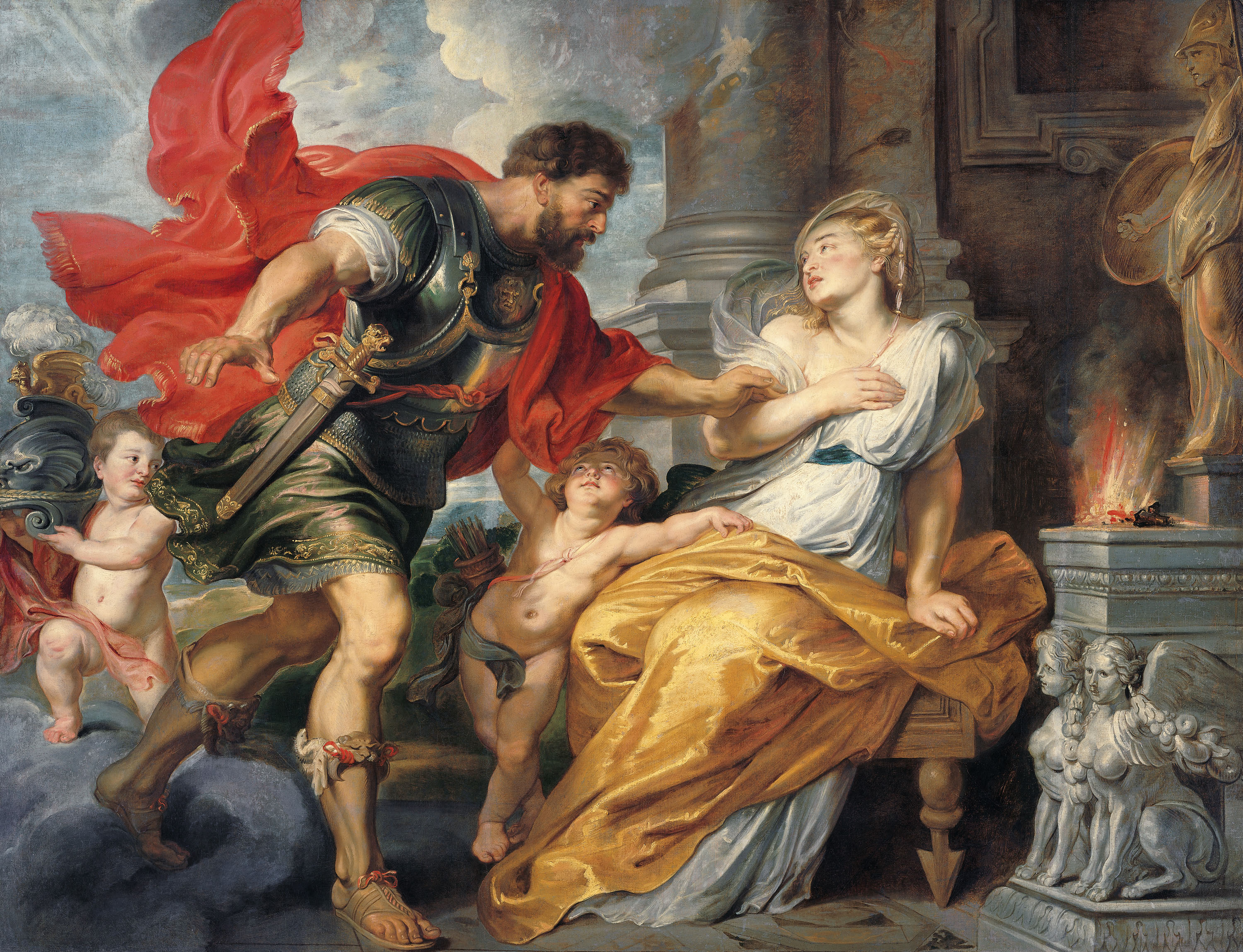
That is Peter Paul Rubens' painting of Mars and Rhea Silvia. According to the legend, Mars loved Rhea Silvia, despite the problematic fact that she was a Vestal Virgin by occupation. Out of their union came Romulus and Remus, the legendary founders of Rome.

Anyway, in the painting, we see Mars advancing upon his beloved, while a couple of cupids remove his armour. Beside Rhea Silvia is the altar of the Temple of Vesta (I particularly like the sphinxes). On the alter, at the extreme right of the painting, is the Palladium, the statue of Athena that somehow (there are various versions of the story) made its way from Troy to Italy.

Now, there is something a little bit unusual about both Mars and the statue of Athena. Can you spot what it is? The answer is in the comments.

Wednesday, March 12, 2008

De Erroribus Zooarchaeologicis


Click to see larger version


That there is the famous Lion Gate, which was built around 1300 B.C. and provided entrance to the ancient city of Mycenae. Your assignment, this afternoon, is to identify correctly the animals portrayed above the Lion Gate (hint: there's a clue in the name of the gate). Ready? Begin!!

* stares at ceiling *

* examines claws *

* reads People magazine *

Ok, pencils down!! Now, to the tricky matter of grading. If you answered that the animals portrayed above the Lion Gate are:


Panthera Leo, as featured on the Lion Gate at Mycenae

...then "Hooray" for you, and you win a prize:


If, however, you are of the same school of "thought" as one of my poor first-year mythology students, and therefore contrived the notion that those animals are:


Meles Meles, as not featured on the Lion Gate at Mycenae

...well, in that case: